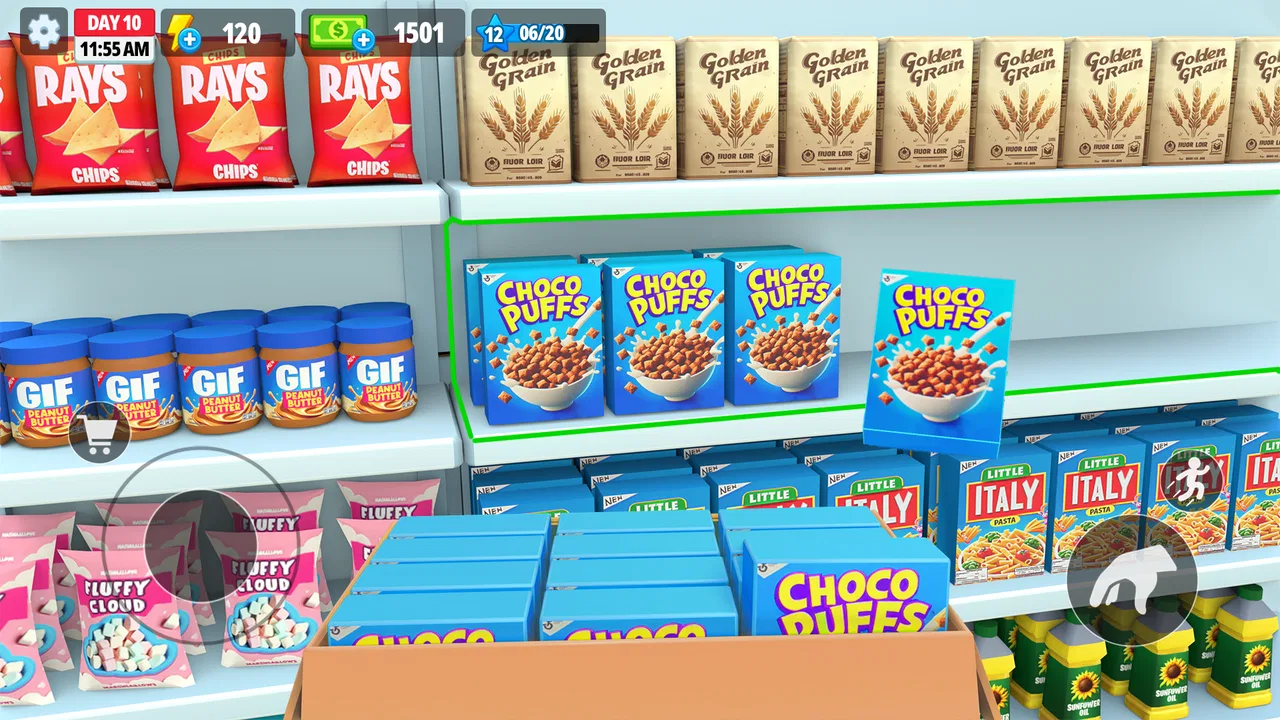
My Supermarket Simulator 3D®
- 4.0
- Rating
- 100.00M
- Installs
- Free
- Price

 Analysis by App-foxy
I approached My Supermarket Simulator 3D® expecting a light supermarket-management game, and that is exactly where it fits best: a casual simulation built around running a shop, ordering products, and gradually expanding the business. It is free to start, rated for Everyone, and made by Game District LLC. After spending time with it, I see the appeal clearly. It turns an ordinary shopping trip into a small chain of decisions about stock, space, presentation, and growth.
The important question is not whether it is a deep business simulator. It is not. The better question is whether you want a simple, hands-on store routine that you can pick up without studying complicated systems. If you enjoy visible progress and short management tasks, this game is easy to understand. If you want detailed economics, realistic retail planning, or a long strategic campaign, you may eventually find it too lightweight.
What to consider before choosing it
I would judge this game by four things: how much control it gives me over the shop, whether the daily tasks stay satisfying, how comfortable the progression feels, and how well the experience suits my available time. The supermarket theme sounds straightforward, but a good simulation needs more than shelves and products. It needs a reason to care about the next improvement.
You May Also Like

 AccuWeather: Weather Radar
AccuWeather Review: A Quick, Clear Forecast for Everyday Decisions
For everyday plans, the best forecast is the one you can understand quickly. AccuWeather makes rain timing, radar, and local conditions easy to act on, with a few trade-offs.

 Hill Climb Racing
Why Hill Climb Racing Still Turns Crashes Into One More Run
A tiny car, a bumpy hill and one more upgrade: Hill Climb Racing keeps resurfacing because its simple chaos makes every near-miss feel personal.

 AliExpress - Shopping App
AliExpress Makes Global Shopping Feel Personal, but Shoppers Bear the Risk
AliExpress turns a global marketplace into a pocket-sized discovery engine. Its reach is useful, its shopping loop compelling, and its trade-offs easy to miss.

 Lords Mobile: Kingdom Wars
Lords Mobile Is a Kingdom-Building Routine, Not a Quick Match
A case-by-case verdict on the building, battles, device demands, and social commitments that make Lords Mobile rewarding for some players and exhausting for others.

 PDF Scanner app - TapScanner
TapScanner Makes Paperwork Easier to Capture, Check, and Share
TapScanner makes scanning with a phone feel less like a rescue operation and more like a dependable step in getting work done. Its capture tools are useful, though not flawless.

 Block Blast!
 Shows How Much a Puzzle Game Can Leave Out
A quiet grid game shows why puzzle players increasingly value instant clarity, repeatable skill and low-pressure play—and where the genre still needs to catch up.
More From Our News Desk
View All News


Here, the main attraction is the direct connection between action and result. I order products, make them available in the store, and work toward a larger supermarket. That loop is much easier to grasp than a simulation that begins with spreadsheets, staff schedules, or complicated financial reports. I can see what needs attention instead of trying to understand a wall of menus.
That simplicity is also the first trade-off. The game is more about managing a shop at a comfortable pace than testing me with difficult commercial decisions. I would recommend it to someone who likes the feeling of building a small business but does not want a demanding management challenge. I would be more cautious with players who need every choice to have several competing consequences.
It also matters that the game is designed for a broad audience. Its Everyone rating makes it a reasonable choice for family-friendly casual play, though younger players may still need guidance around optional purchases. The title is free to download, while individual in-game purchases range from $0.99 to $59.99, so I would decide in advance whether I am comfortable spending money on faster or more convenient progress.
The shop routine is the real hook
The strongest part of the experience is the ordinary rhythm of running the store. A supermarket is familiar enough that I immediately understand the goal, but interactive enough to give small tasks a sense of purpose. Ordering goods is not an abstract button hidden in a management screen; it represents the practical problem of keeping a store ready for customers.
I like this kind of design because it gives casual players a clear next step. When I open the game, I do not need to invent a complicated plan. I can look at the store, think about what it needs, and work toward improving it. That makes the game comfortable for short sessions, especially when I want something more active than a puzzle but less demanding than a full strategy game.
A useful way to play is to treat each visit as a small work shift. First, I check what the shop needs. Then I handle the most obvious supply task before spending attention on expansion. This prevents the common mistake of chasing a larger store while neglecting the basic products that make the existing space useful. Growth feels better when the current shop is already functioning well.
The supermarket setting also makes progress easy to read visually. A bigger or better-organized store feels different from the starting point in a way that a purely numerical simulator may not. That visual feedback is a major reason I can imagine returning for another session, even when the underlying decisions remain simple.
Why the accessible design works
Game District LLC has chosen a theme that explains itself. I do not need specialist knowledge of retail to understand the basic relationship between ordering products and expanding the shop. That makes the game approachable for people who normally avoid simulation titles because they expect complicated controls or dense instructions.
The game also benefits from being a familiar fantasy. Many people have wondered what it would be like to run a supermarket, even if only for a day. This turns that idea into a manageable routine without asking me to learn an entire industry. The result is not a serious retail course, but it is an inviting introduction to simulation games.
I would especially suggest it to players who enjoy gradual improvement. The satisfaction comes from seeing a modest store become more capable over time, not from a single dramatic event. That makes it a good companion for relaxed evenings, waiting rooms, or brief breaks when I want a game with a clear objective and low pressure.
Three practical ways I would play it
My first approach would be the “stability before expansion” method. I would focus on keeping the shop supplied and understandable before chasing every available improvement. This helps avoid a common simulation-game problem: building outward so quickly that the original operation becomes difficult to manage.
My second approach would be to use the store as a visual checklist. Instead of tapping through tasks randomly, I would scan the aisles and identify the most noticeable weakness. Is the shop lacking products, room, or a clearer sense of progression? Choosing one priority at a time keeps the routine from feeling scattered and makes each session easier to resume.
My third approach would be to separate entertainment goals from efficiency goals. Sometimes I would play to make the store look and feel more developed; other times I would focus on completing the next practical objective. That distinction matters because a casual simulation can become frustrating when I expect every action to be financially optimal. This game is more enjoyable when I allow room for experimentation.
These habits are not complicated tricks, but they change how the game feels. They turn a sequence of small tasks into a personal routine and reduce the temptation to spend simply because progress seems slow. I would rather understand what I am trying to improve before considering an optional purchase.
Where it beats other simulation choices
Compared with a detailed tycoon game, this supermarket simulator wins on immediacy. I can understand the setting almost instantly, and the store gives me a concrete place to improve. A deeper business game may offer more variables, but it can also make the first hour feel like administrative work. This one is better when I want the visible satisfaction of managing a physical space.
It also has an advantage over idle-style management games for players who want to feel involved. In an idle game, much of the appeal comes from returning to collect progress. Here, the supermarket theme suggests more direct participation. I am not merely watching numbers rise; I am thinking about stock and expansion as parts of the shop’s daily operation.
Against decorating games, the appeal is different. Decorating-focused titles usually make appearance the central reward. My Supermarket Simulator 3D® gives the setting a practical purpose: the store is not just a room to make attractive, but a business to operate. I would choose this game when I want organization and growth to matter alongside presentation.
The game is also a good middle ground for people who find full management simulations intimidating. It has enough structure to feel like a business game, but the supermarket theme keeps the objectives familiar. That makes it easier to recommend as a first step into the simulation category.
Its broad reach supports that impression. The game has passed 100 million installs and holds a 3.7 average from around 532 thousand ratings, with roughly 5 thousand written reviews. Those figures suggest that the concept has connected with a large casual audience, while the middling average is a useful reminder not to expect a universally deep or polished experience.
Where another type of game may fit better
I would choose a more advanced tycoon game if my main goal were complex planning. Players who enjoy balancing several departments, analyzing detailed income, or dealing with difficult long-term consequences may want a system with more layers than this one provides. The supermarket theme alone will not satisfy someone looking for a serious economic model.
I would also look elsewhere if I wanted a story-driven experience. This game’s appeal comes from operating and expanding the store, not from following a rich cast of characters or a dramatic narrative. A life simulation may be a better choice for someone who wants relationships, personal customization, and a broader world around the business.
There is another important distinction between a relaxed simulator and a competitive game. If I want leaderboards, direct multiplayer rivalry, or a strong social component, this is probably not the first category I would select. Its appeal is personal progress inside the supermarket rather than proving my management ability against other players.
Players who dislike free-to-play pressure should also think carefully before installing. The game is free, but optional purchases can reach $59.99 per item. I would not treat that as a reason to reject it automatically, yet I would approach progression with a clear spending limit. The best experience for me is to enjoy the management loop first and view purchases as optional rather than necessary.
How the version and device fit affect the decision
The current version is 1.27.1, and the listed minimum operating system is Android 7.1. That makes the game accessible to a wide range of Android devices, including some older phones. Even so, compatibility is not the same as comfort. A supermarket with a three-dimensional presentation can feel less pleasant on a small or aging device, especially if controls or visual details become difficult to read.
I would test the first session on the device I plan to use most often before making any purchase. That is particularly sensible for a game built around repeated short interactions. If the screen feels cramped or the phone becomes uncomfortable during play, the problem will affect every later session, not just the opening tutorial.
The age rating of Everyone makes the game suitable for a general audience, but parents should still explain that free games may contain optional purchases. For a shared family device, I would use the platform’s purchase controls and agree on expectations before handing the game to a child. That is a practical step, not a criticism of the supermarket concept.
The real cost of switching from another game
Switching to this title is easy if I am coming from a casual simulation. The theme explains itself, the goals are familiar, and I do not need to learn a complex fictional universe. The bigger adjustment is for players moving from a deep tycoon game. They may initially feel that the supermarket does not demand enough forecasting or risk management.
There is also a time cost in changing expectations. If I am used to games where every minute produces a major strategic decision, this one may seem repetitive. I need to enjoy incremental progress and practical routines. The store becomes rewarding when I notice small improvements, not when I expect constant surprises.
On the other hand, switching away from a more complicated simulator can be refreshing. I can keep the familiar fantasy of running a business while removing much of the mental overhead. That makes this a useful choice for a tired player who still wants to manage something but does not want to calculate every possible outcome.
I would also consider the cost of restarting my habits. In a casual game, it is tempting to spend early because a purchase appears to remove friction. I prefer to play several sessions without paying, learn which parts I actually enjoy, and only then decide whether the optional purchase model suits me. That approach keeps the decision about enjoyment rather than impatience.
Who should install it
I think this is a good match for someone who wants a friendly supermarket simulation with clear goals, visible development, and a familiar setting. It suits casual players, people exploring the simulation category for the first time, and anyone who enjoys turning a small operation into something larger without facing a dense business model.
It is also a sensible choice for a player who likes short, repeatable sessions. I can imagine opening it during a break, handling a few store tasks, and leaving with a feeling of progress. That is more appealing than a game that requires a long uninterrupted session before anything meaningful happens.
I would skip it if I need advanced economics, a substantial story, competitive multiplayer, or a completely purchase-free progression model. I would also avoid it if repetitive management routines quickly lose their charm. The game’s strengths depend on liking the simple loop, so no amount of popularity can make it the right choice for someone seeking a different kind of simulation.
My recommendation after weighing the trade-offs
My recommendation is positive, with a clear condition: install it for a relaxed store-building experience, not for a realistic retail-management challenge. The familiar theme, accessible structure, and visible sense of expansion make it easy to return to. I especially like that it gives casual players a direct way to understand what they are doing instead of burying the supermarket behind complicated systems.
At the same time, I would keep expectations realistic. The 3.7 average shows that broad popularity does not automatically mean every player will find the depth or progression satisfying. The free entry point is useful for testing that question yourself, but the optional purchase range means I would set a personal budget and avoid treating spending as part of the basic strategy.
For me, the deciding factor is mood. When I want a calm simulation with a concrete place to improve, this game makes sense. When I want a demanding tycoon, a story, or a social competition, I would choose another category instead. Install it if the simple pleasure of running and expanding a supermarket sounds enjoyable; skip it if you need every management decision to be complex.
That is ultimately why I can recommend it to a friend without overselling it. It knows how to make a familiar business feel interactive, and it offers an approachable path into simulation games. Its limits are equally clear, but for the right player, the uncomplicated routine is not a weakness—it is the reason the game works.
FAQs for My Supermarket Simulator 3D®
01What is My Supermarket Simulator 3D®?
My Supermarket Simulator 3D® is an engaging simulation game where players manage their own virtual supermarket. You oversee inventory, customer service, and store upgrades, creating a dynamic and immersive experience. The game is available for both Android and iOS, offering intuitive controls and realistic graphics that simulate the challenges of running a real supermarket.
02Is My Supermarket Simulator 3D® free to play?
Yes, My Supermarket Simulator 3D® is free to download and play on both Android and iOS platforms. However, the game includes in-app purchases that allow you to buy additional items, currency, or upgrades. These purchases are optional and designed to enhance gameplay, but they are not necessary to enjoy the full game experience.
03What are the main features of My Supermarket Simulator 3D®?
The game boasts a variety of features including realistic store management, customer interaction, and detailed inventory systems. You can expand and customize your supermarket, hire staff, and compete in challenges. Graphics are visually appealing, and the gameplay is designed to be both educational and entertaining, providing players with a comprehensive supermarket management experience.
04Can I play My Supermarket Simulator 3D® offline?
My Supermarket Simulator 3D® requires an internet connection for certain features like updates, in-app purchases, and online leaderboards. However, basic gameplay functions can be accessed offline, allowing you to manage your supermarket without a continuous internet connection. For the full experience, occasional connectivity is recommended.
05What are the system requirements for My Supermarket Simulator 3D®?
For Android users, My Supermarket Simulator 3D® typically requires Android version 5.0 or higher. On iOS devices, it usually requires iOS 11.0 or later. The game is optimized for both tablets and smartphones, ensuring a smooth gaming experience across a range of devices. Adequate storage space is also necessary to install and update the game.
Pros
- Realistic 3D graphics enhance immersion.
- Varied tasks keep gameplay engaging.
- Intuitive controls for easy navigation.
- Customizable stores add personal touch.
- Regular updates with new features.
Cons
- Occasional in-app purchase prompts.
- Requires internet for full features.
- Some ads interrupt gameplay.
- Limited offline mode functionality.
- High battery consumption on older devices.

My Supermarket Simulator 3D®
Gallery